Have you noticed what we condone for kids?
Children’s clothes. They make up a brightly colored block at the mall, their images and text leap out at Walmart and Target, they appear as gifts for every Holiday. Kids, being the changing and growing beings that they are, tend to cycle through them fairly quickly. This means that more clothes can get bought to replace old ones fairly quickly as well. Due to this impermanent nature, you’d think that they would just be blips on the radar. But kids get incredibly attached to their clothes, and the content on them can affect how they feel about themselves and others.
Physical Construction
Sizing (children’s actual growth vs sizing differences)
When you think of men’s vs women’s clothing sizes, there is an obvious difference in what is considered a small. But when you think of boy’s and girl’s sizes, do you think of a difference there? For teens and tweens, perhaps, but for elementary school aged kids? toddlers? babies?
For babies, the sizes are fairly consistent. Thankfully, a onesie seems to be a onesie, with the exception of frills and embellishments added to ones intended for girls.
But starting from children’s sizes, there is a significant difference in the offerings for girls and boys. Even as small as the toddler sizes- a boy’s 2T is more equivalent to a girls 3T. Are toddlers different sizes? for that matter, are children?
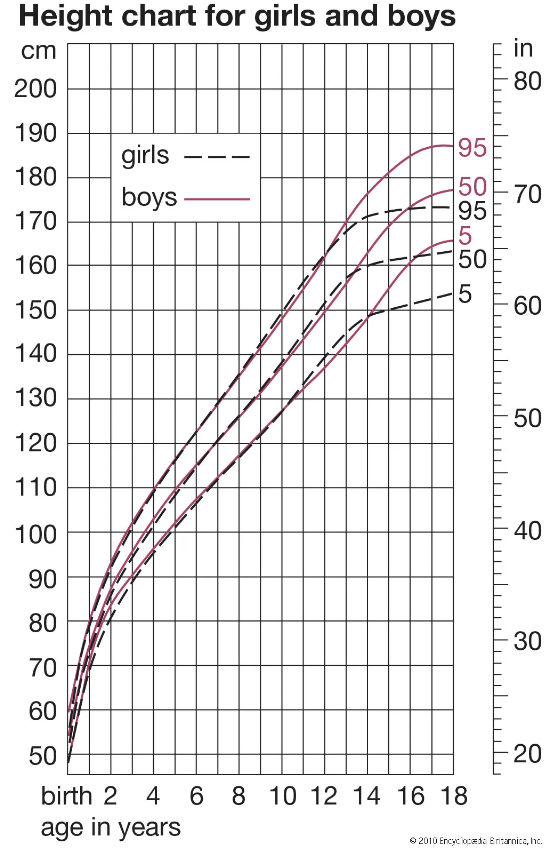
As is easily seen in this chart, boys and girls are virtually indistinguishable until age 11 or 12. This chart is in centimeters, with the inches on the right. There isn’t a full inch of difference in any percentile until age 14. To head off the argument that “the largest girls might be the same size as the largest boys, but the average girl and the average boy are different!” I invite the reader to consider that this chart shows the 95th percentile, the 50th, and the 5th. If the average was truly different, then the top and bottom lines would be consistent to one another, with the middle (50th) would be different. It is not. But this is just height, let’s check weight as well, in order to cover the bases.
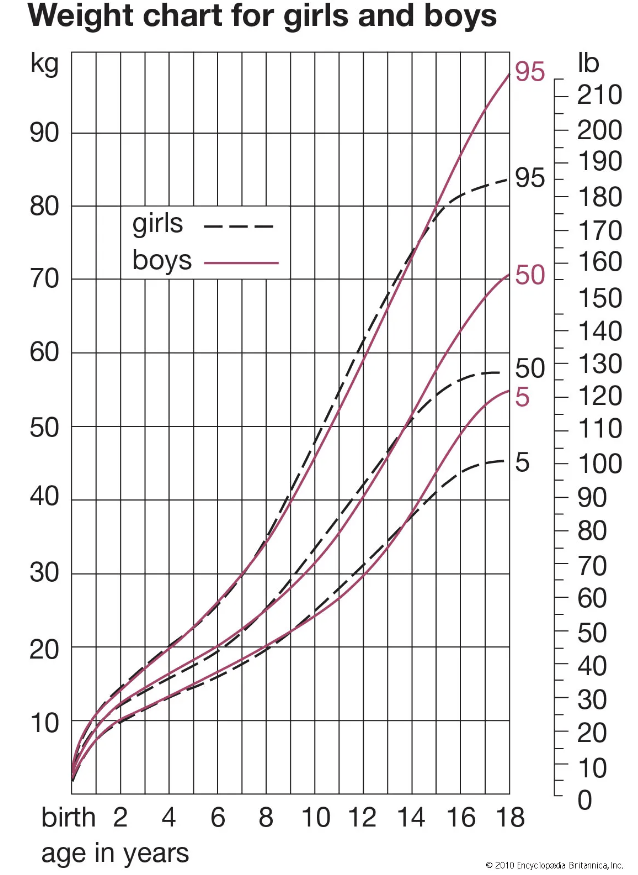
from Brittanica
In this chart, the genders are again indistinguishable until about 14, with the first instance of a full 10 lbs of difference occurring at 15. So if boys and girls aren’t any more than 1 inch and 10 pounds apart in size until age 14, why is there a discrepancy in size starting at 2T? There is no physiological reason for that decision. But of course, it only gets worse as the children get older.
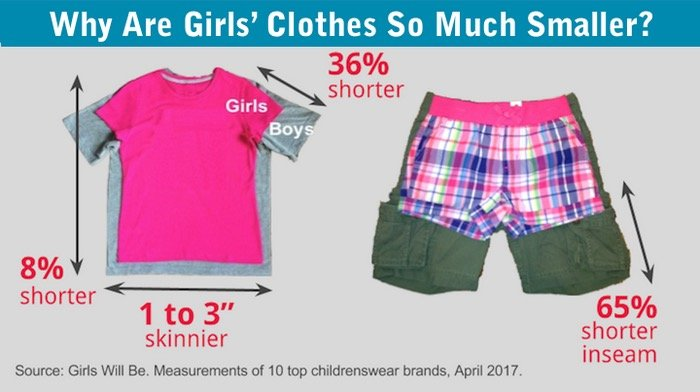
When comparing children’s sizes 6 and 10, Choksi found that girl’s shorts are 65% shorter at the inseam than boy’s. The worst part? At size 10, the girl’s shorts were between 4 and 6 inches shorter than the size 6 boy’s shorts. This means that girls have to size up more than three sizes just to get the same amount of leg coverage, likely making the waist completely incorrect.
As for short sleeved shirts, girl’s sleeves are 36% shorter, and the body is 3 inches skinner and 8% shorter. Beyond the implications for dress codes, this sets up a dangerous precedent around sizing insecurity. There is nothing wrong with girls preferring certain styles, shorter or longer, but when there isn’t an option for more coverage, girls who want that will start to think something is wrong with them. And simply shopping in the boy’s department is not the solution for many girls who still enjoy the feminine branded colors.
The example provided in the Austin-American Statesman was a set of twins who had to get different sizes despite being exactly the same size, because one was a girl. This girl is bound to notice eventually that her clothes are labeled as being a size larger than her brother’s- leading to her asking if she is bigger than he is (she is not) and facilitating the beginning stages of body dysmorphia.
Don’t believe me? Think I’m taking it too far? The Commission on Gender Stereotypes in Early Childhood report Unlimited Potential outright states that 36% (over 1/3) of 7-10 year old girls say “they are made to feel their looks are their most important attribute” which leads to both eating disorders and suicide attempts. I don’t think it’s a leap at all to say that the clothes girls wear being visibly labeled as larger despite in actuality being smaller contributes to girls feeling negatively towards themselves.
Quality
Okay, so we know that boys and girls, despite being the same size until they’re fully teens, have wildly different clothing sizes. But surely the rest of the difference have to do with decorations, right?
No, unfortunately, the quality of fabric and construction are also different. The boy’s fabrics are thicker, sturdier, wear out less quickly, and are overall warmer. Many people may be tempted to say, “well, boys are harder on their clothes!” And to that my response is: is that because they’re encouraged to be dirty and messy, and girls are reprimanded for it? Is that because they’re actually harder on their clothes, or is that because girl’s clothes break faster, so they’ve learned how to be more gentle? Is that because they have more options that can get dirty and be completely cleaned, facilitating low-consequence play, whereas girls have clothes with delicate add-ons (lace, sequins, glitter) that get ruined?
Construction wise, this is the thing I find most disappointing personally as someone who loved to pick up rocks as a child. The saga of women everywhere is perpetuated in little girls- their clothes don’t have pockets. I suppose with 65% less shorts, there’s less room for pockets.
Content: colors, graphics, text
Now that we’ve examined the underlying structures, in the sizing as well as construction, we can look at the decoration. The content on the items. The colors, graphics, and text. But before I do, what do the Committees of Advertising Practice (CAP) and the Advertising Standards Agency (ASA) have to say about stereotypes?
CAP says “harmful stereotypes… contribute to how people see themselves and their role in society“. Alright, fair enough, stereotypes affect how people think they can live in a society. The ASA says “Young children… need protection from harmful stereotypes as they are more likely to internalize the messages they see.” So children not only are affected by stereotypes, they are more likely to internalize them. Internalizing a stereotype means that the child now perceives it as fact, affecting what they believe is possible, not just what they believe will be accepted.
Colors
The traditional pink for girls and blue for boys has only been “traditional” since the 1950s. But more on that later. What is currently on offer at Walmart? Walmart being a giant chain brand is attuned to what the masses want, and what they expect to be readily available to them. This isn’t trends confined to a fancy specialty shop, this is what everyone has access to.
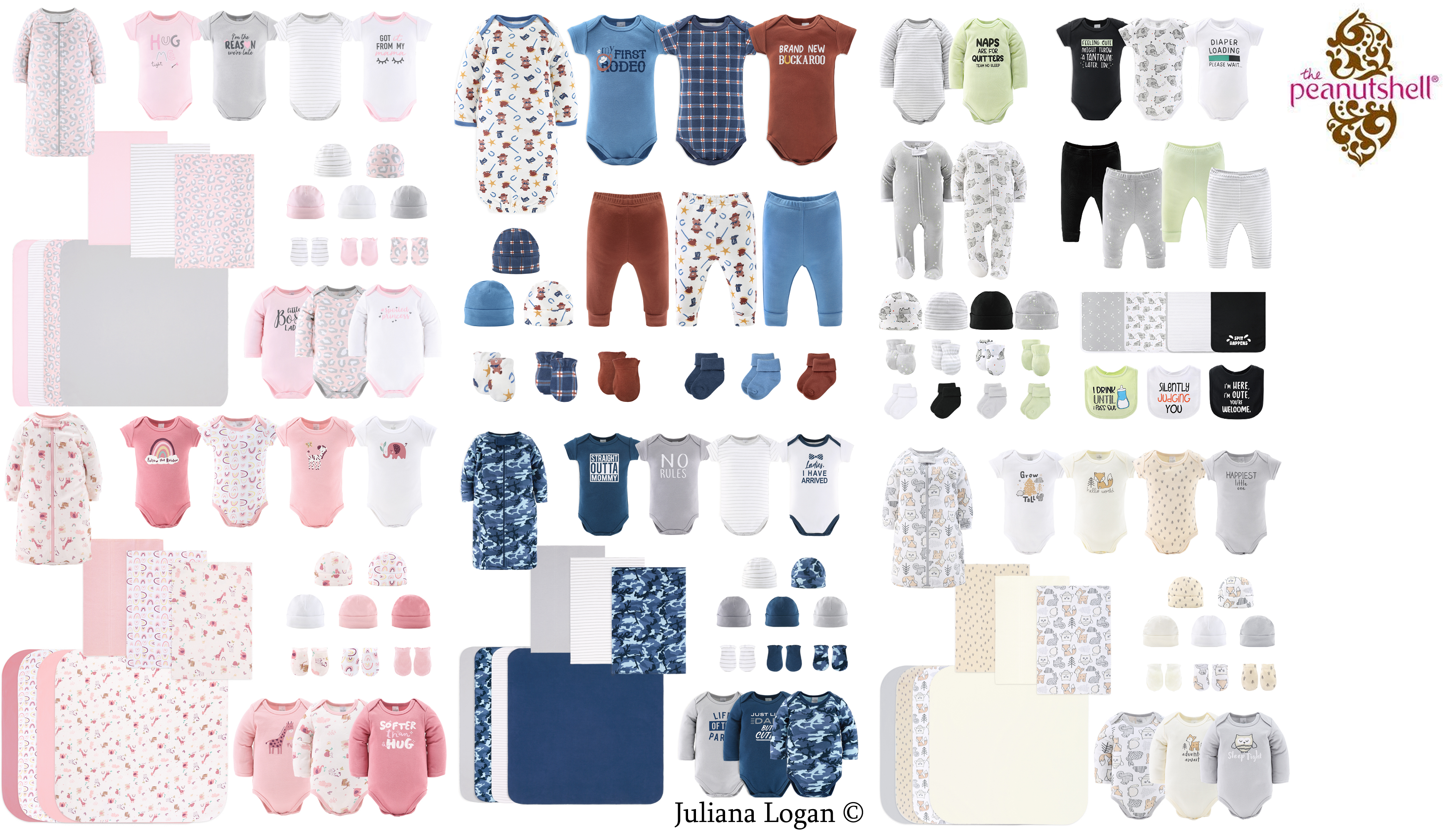
In a push towards gender neutral clothing, many brands have decided on yellow and green as neutrals. The Peanutshell is one notable example of this at Walmart, with both yellow and green in their neutral collections. One of their boy’s collection, however, includes a very russet red. Notably, the boy’s colors are all much more saturated than the girl’s and the neutrals, apart from one neutral set including black.
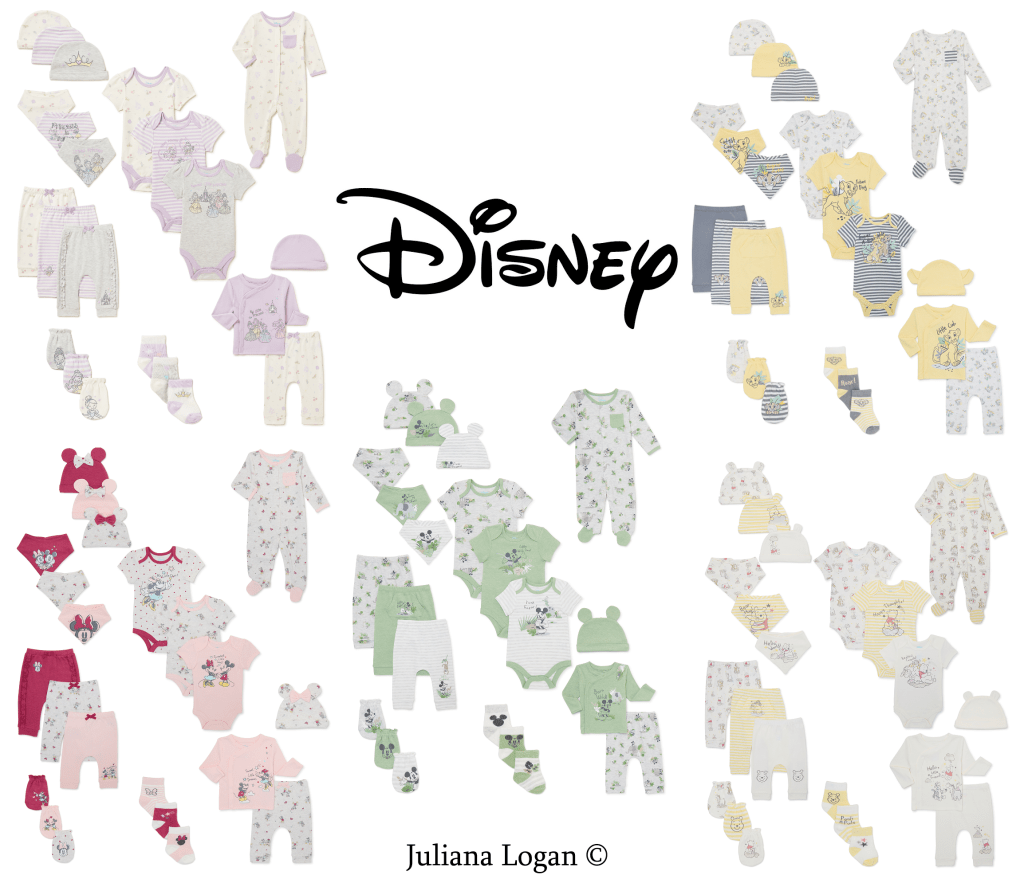
Disney’s available collection at Walmart keeps pink for girls, leans into yellow as a neutral, but uses green for boys. There is a pale pink as well as a more saturated pink collection, but the two yellows are very similar in tone, although Pooh is ever so slightly more pastel. The green boy color is a midpoint in saturation between the two girl pinks, most similar to the brighter yellow.

The Disney collection that I found most interesting however was the Toy Story set. It is the only nongendered set that includes pink, but it also has green, blue, orange, red and yellow. The only color missing to make it a full rainbow is purple, but it isn’t at all garish due to the grey and white fabric.

Honest baby clothing only had girl’s and neutral clothing available. The neutral is a very seafoam green, and the pink girls set includes a much more saturated near-red tone, similar to Disney’s.
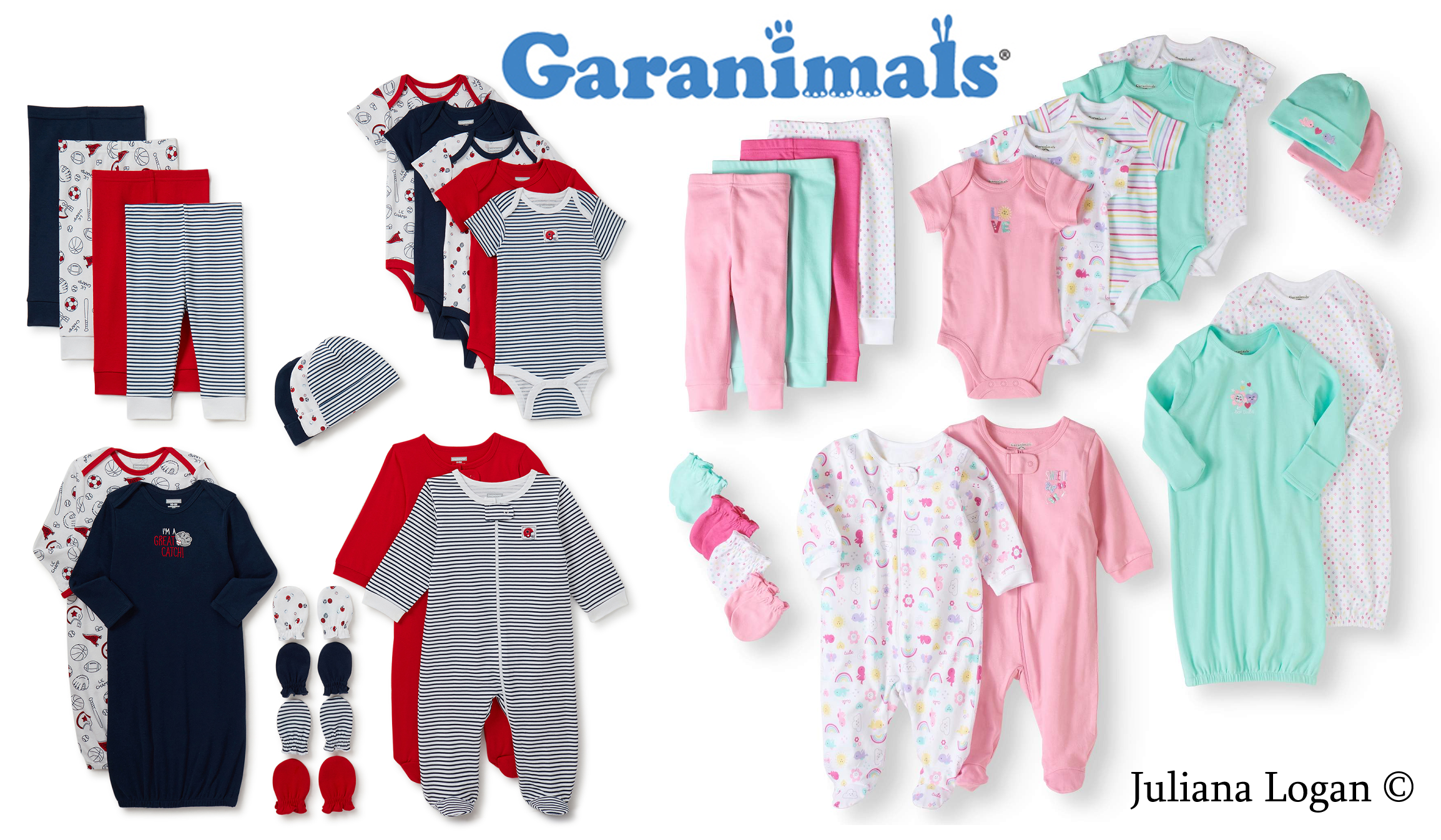
Garanimals did not have a neutral option. Their boy’s set is very red and navy blue, and their girl’s set is pink and a much brighter seafoam green than Honest’s neutrals. This marks the second set to include red in their boy’s clothes, including the Peanutshell.
Remember how I said I’d discuss blue for boys and pink for girls? Well, here it is. Red is a strong color, and it was traditionally considered masculine to wear any strong color. Pink, as a variant of red, was also considered strong and masculine; while blue being much less aggressive was a girl’s color. There was a period of time in which both were acceptable, and then the switch was made. The extreme wave of pinkwashing really took off in the late 80’s and has determined the “correct” colors up until today. This was so heavily utilized that 86% of toys that were pink were marketed as “girls only”, while the boy’s colors were red, black, brown and grey.
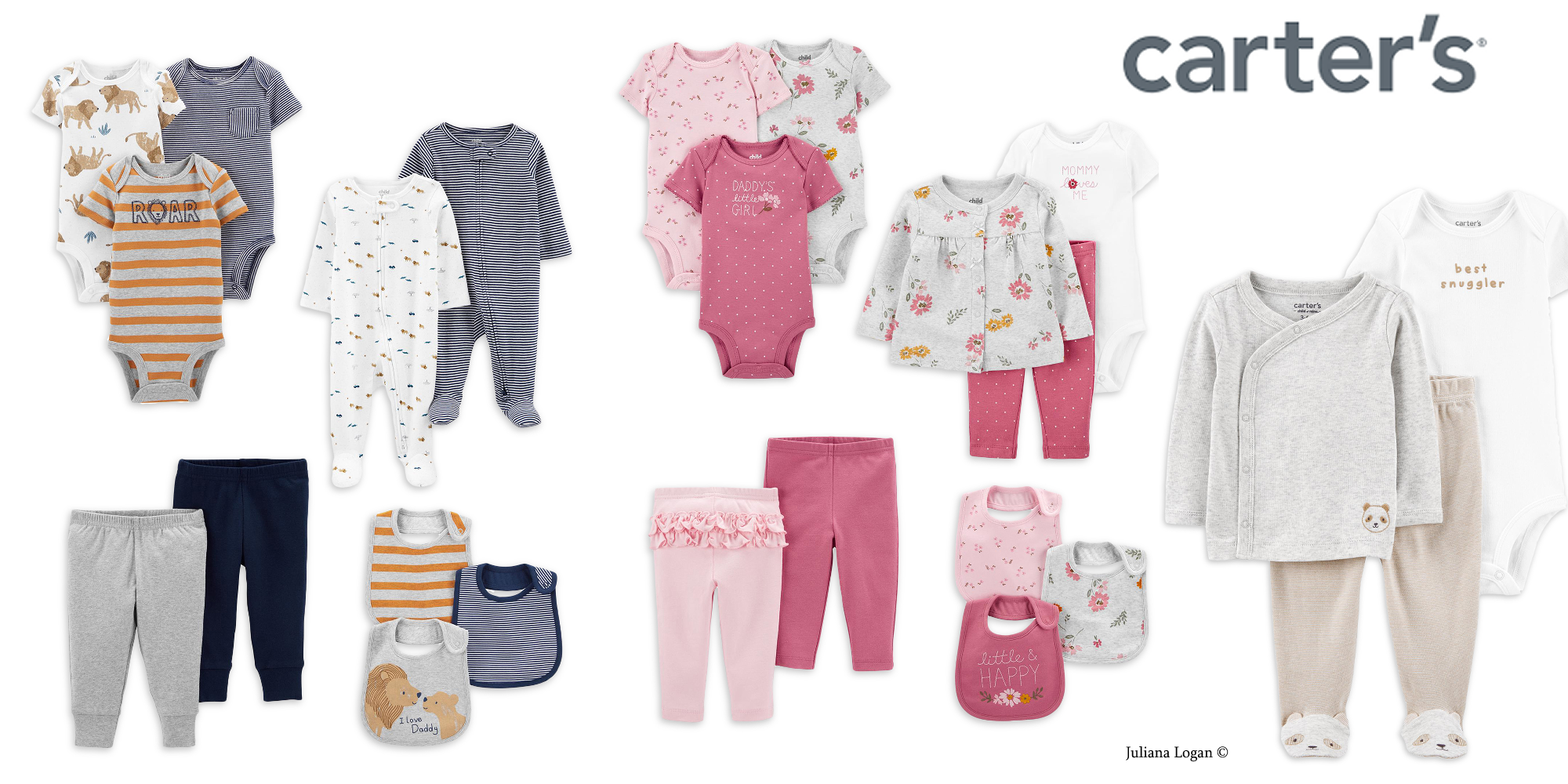
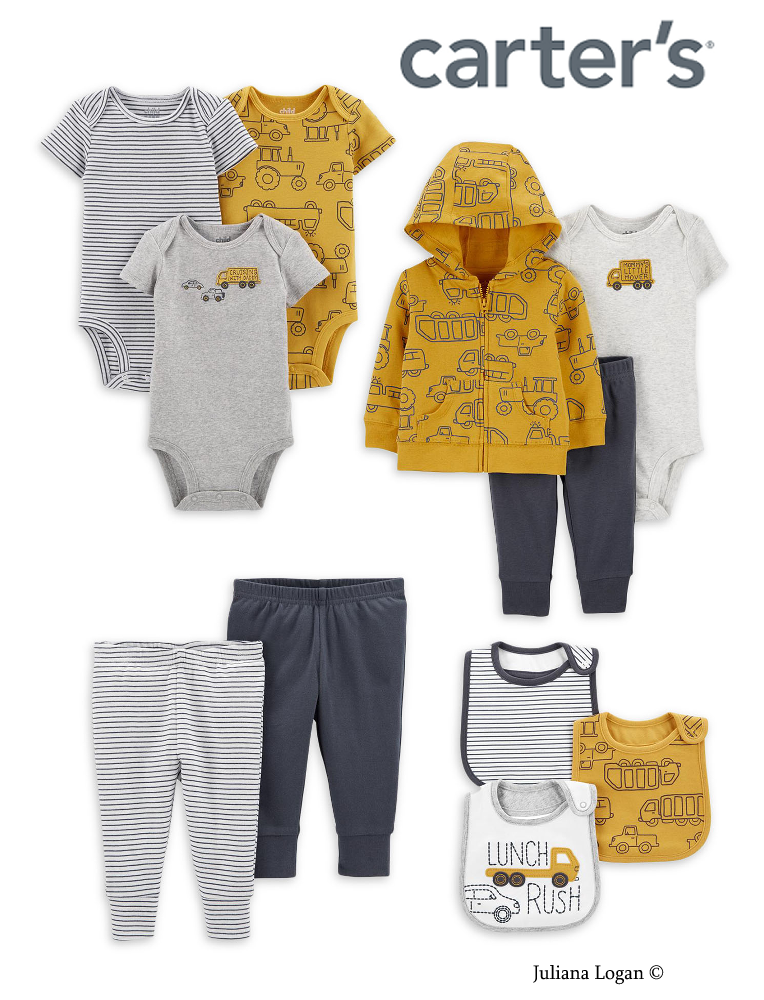
Carter’s, by contrast to Disney and the Peanutshell, keeps pink for girls but has yellow and orange for boys. They seem to do a fair amount of masculinizing their yellow items though- notably the lions in the first image and the trucks in the second. They are also including beiges as neutral.
The Instagram aesthetic moms tend towards beige, which has been made fun of notably by a creator who refers to them as “sad beige babies.” The popularity of this may have something to do with Montessori as a rising education trend. The Montessori method takes into account children’s developmental milestones, including their ability to see color, and recommends neutrals so as to not overwhelm them when they’re still learning how to interact with their environment.
Graphics: trucks, food, animals (eyes closed)
In order of their appearance, we’ve already seen horseshoes, sports, and trucks for boys; rainbows, princesses, florals, and hearts for girls; and woodland scenery and leaves for unisex onesies. I won’t get into the general graphics, as I’d like to focus on some specifics, namely animals, dinosaurs, and food.
Animals
You may have already noticed some animal graphics pop up. In order of appearance, there were zebras, elephants, giraffes, mice, birds and butterflies for girls; bears, mice, and lions for boys; elephants, deer, squirrels, bunnies, owls, foxes, bears, lions, dinosaurs, pigs, dogs, and pandas as unisex. The mice appear on both boy’s and girl’s clothing because of Mickey and Minnie mouse. The gender neutral category had the most animals by far, likely because most children like animals regardless of gender. You might notice that all of the non-character girl’s animals are prey, whereas both of boy’s are predators.
I will discuss the implications of this in the following section.
Boys as predators, girls as prey
After a survey of 1,444 children’s clothes with animals on them from 12 British retailers, Blod Design looked into the gendered statistics. Some animals appeared on both lists, but this was due to specific characters and franchises rather than the animal itself. This meant mice (due to Mickey and Minnie Mouse) and pigs (Peppa and George Pig) were present for both genders, but I will be excluding them from my discussions.
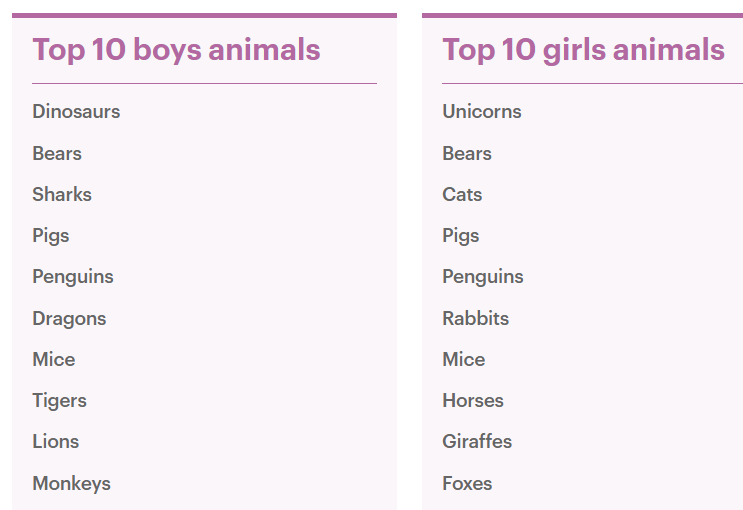
Boy’s top 8 (subtracting mice and pigs from the top 10) are nearly all meat eaters, with different species of monkeys consuming different amounts of meat. 6 of them I would personally consider predators. And all 8 are wild, if you consider dinosaurs, which I would.
Girl’s top 8 only includes 4 meat eaters, and I would only consider 2 predators. But 5 of them are wild- again, considering unicorns wild. Sure, there are wild horses and rabbits, and feral cats, but I’d bet that the ones depicted are cute and friendly and not at all reminiscent of their wilder counterparts.
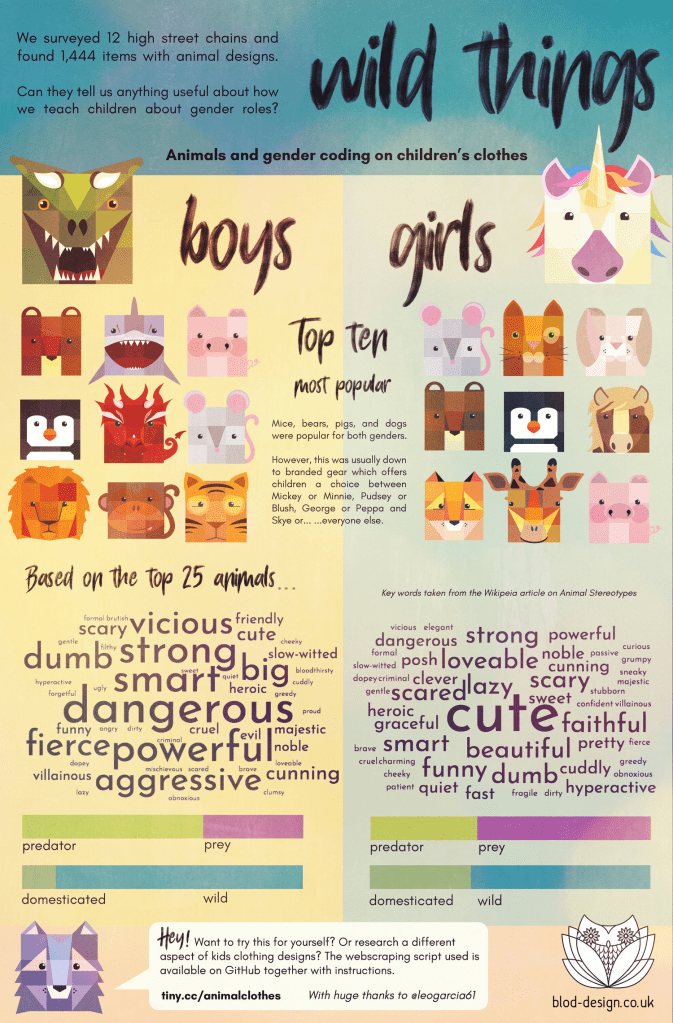
The words associated with the animals are clear as day on the infographic, with boy’s animals being dangerous, powerful, aggressive, and strong, girls overwhelmingly are cute, loveable, and beautiful. The largest boy’s associations are about what they can do, their actions, and girl’s are their appearance or relevance to others. Sonshine magazine claims that the message behind these particular animal noises is that “boys can express anger and aggression… and deeper, perhaps the boys are entitled to chase, harrass, overpower the girls – that’s just nature.” And, of course, that it leads to aggression as the only valid form of expression, as well as fostering entitlement from boys.
Now, this all sounds negative for any girls they encounter. Fortunately, challenging these stereotypes in childhood has been proven to reduce violence against women and girls. But it’s a negative for the boys themselves as well- unrealistic expectations surrounding emotions as well as other “manly” stereotypes have led to higher suicide rates among men.
Girls’ animals have eyes closed
The opposite of the boy’s aggression? Submission for girls. This manifests not only in their clothes depicting prey animals, but also the way the animals themselves are depicted. A significant number of the animals marketed towards girls have their eyes closed- what one tiktoker claims is modeling quiet, demure existences for girls. Some of the onesies already pictured here, in fact, include animals with their eyes closed for girls, and there will be more examples to come.
Dinosaurs
As a kid who loved dinosaurs, who watched Walking with Dinosaurs, Walking with Monsters AND Walking with Beasts; I was particularly interested in what dinosaurs looked like on children’s clothes. They’re listed as number 1 for boys, and do not appear anywhere in the girl’s top 10. But I know dinosaurs marketed towards girls exist, and I’ve managed to find a fair few of them.
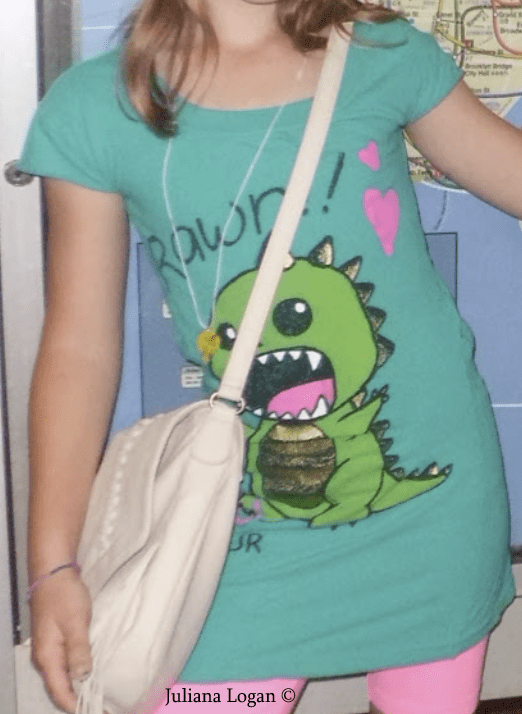
This teal shirt with a green dinosaur says “Rawr!! It means I love you in dinosaur” and features a green and glittering gold stylized chibi dinosaur with visible teeth. It was also from the women’s section, my mother altered it for me to make it more of a T-shirt dress. I’ll be referring back to it a few times, but I thought it would be good to include, so that you know how invested I am in dinosaurs.
Portrayal
Dinosaurs, of course, weren’t more or less deadly when they were females or males. In fact, most female dinosaurs were larger and therefore more intimidating, just like the majority of reptiles today.

Most generally, girls get more herbivores on their clothing, vs carnivores on boys. These two shirts from the children’s place demonstrate this, among a few other points. Others I’ll get into later, but I’d like to point out that other than the teal meat eating dinosaur on the bottom left, none of the girls herbivore dinosaur shirts include teeth.

These two shirts are from Walmart, both for girls. The one on the left includes something a lot of girl’s dinosaur shirts are guilty of-accessories. The Children’s Place girls dinosaurs boast flower crowns, the Walmart one has a bow, and a later dino has a crown. Boy’s dinosaurs, by contrast, are usually unadorned, unless they have sunglasses or a hat.

These two dinosaurs demonstrate the previous phenomenon of the “eyes closed for girls”, as well as being both herbivores. They are also full of glitter and feature pink. But here’s where the text starts to jump out at me.
Many of these shirts use text to tone down the dinosaur and frame it more softly. Why does a Triceratops (tri meaning three, being three horned is part of their whole brand) have to be “the original unicorn” in order to be girl-friendly? And why must this long necked dinosaur be a “snuggle saurus”? The most common long necked dinosaurs are diplodocus and brachiosaurus, and judging by the lack of a significant head crest, it’s not a brachiosaurus, and therefore the “saurus” suffix isn’t even relevant! My own shirt included the “rawr means I love you in dinosaur” text, and sported hearts just as the snugglesaurus does.

I’d like to call attention to the Amazon dinosaur, the only one that does not attempt to make itself more cutesy for girls. Unfortunately though it does include a large flower crown, so it is not free of being toned down by its accessories.

These four designs fall under the “not like other girls” trend. Claiming that these dinosaurs are for girls while implying that this is unusual and unique. The Children’s Place shirt from earlier did the same- and the boy’s shirt had no text at all, making it clear that boys do not need a reason to like dinosaurs, but girls must declare that they do, actually. These final two also include a personalized name, which does not help their “not like other girls” vibe.
Food
The next category of graphics that appear on children’s clothes is food. The stereotyping here is that boys get meat and calorie rich foods- mac n cheese, burgers, steak, hot dogs, pizza- whereas girls get sweet things- lollipops, ice cream, candy, cake, all sorts of fruits. As Alysa Levene, social historian says, it’s that sort of hunter vs sweetheart, manly vs beautiful juxtaposition.
In the infant to 6 year old category, boys had 6 shirts featuring food whereas girls had 25. This emphasis on food from a young age makes girls much more aware of their consumption. Beyond the numbers, girls are the only ones who get vegetable prints, in addition to their bountiful fruits. Anthropology Professor Emerita did a food study and found that “restricted eating, thinness, and denial of appetite are appropriate for girls, and that hearty eating, bigness, and expression of appetite are appropriate for boys.”
Girls as the food, boys featuring the food
The truly terrifying thing for me, though, is similar to the predator vs prey ratio from the animal section. It’s that boy’s food is pictured with a character. It’s featuring the food. Girl’s clothes just have food, or that food is anthropomorphized. An ice cream cone with eyes, a cake with a face, fruit with a smile. The girls are encouraged to empathize with the food, to become the food. And the boys are encouraged to eat it. As Refinery29 says, “Boys would dominate the hell out of a snack, while girls are merely meant to look like one.“
Text
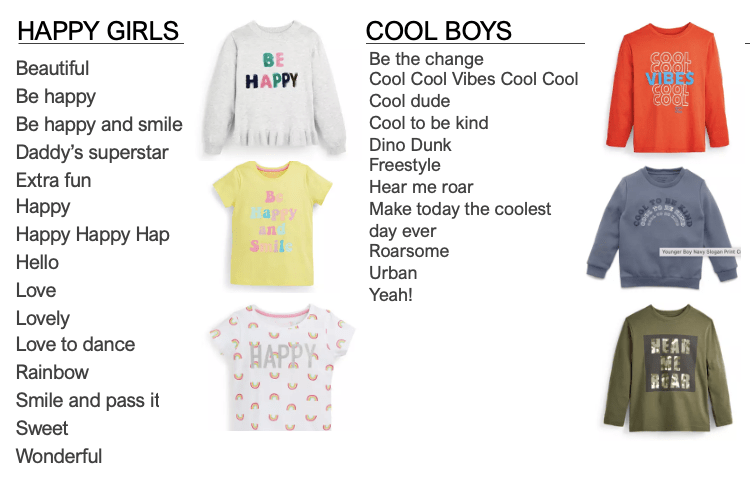
Adjectives for boys
- epic
- extraordinary
- geniuses
- cool
- brave
- legendary
- adventurous
- strong
- Roarsome
- unstoppable
- wild and free
Adjectives for girls
- Cute
- Simply Adorable
- Lovely
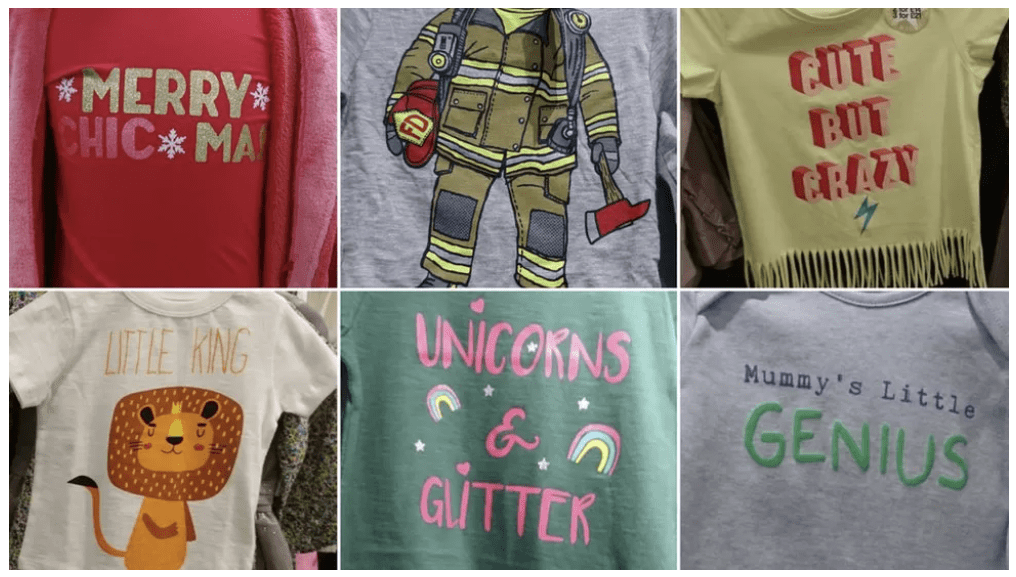
“Be” for boys
- rule breaker
- not interested in what you’re saying
- heroes in training
- building the future
- leader of tomorrow
“Be” for girls
- Just a little crazy
- cute but crazy
- be kind
- be perfect
- take it easy
- smile
(sonshine) raemona
I think Sonshine magazine summarized these slogans best. Boys are told “Their aggression is their value…. they are cleverer, more important, worth more. That they deserve more. That they are entitled to more.” Girls are told their visual appearance is most important, and that they are not worthy of having a concrete future or using their brains. To the point that Morrison’s marketed “Little Man, Big Ideas” and “Little Girl, Big Smiles” side by side.
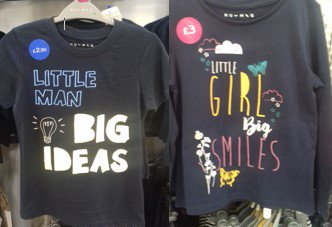
Beyond the “little man” vs “little girl” distinction being incredibly demeaning, this brains vs beauty sets girls up for failure. It’s been proved that by the age of 6, girls will avoid subjects they think require them to be “really really smart” and leads to less confidence in pursuing STEM later in life.
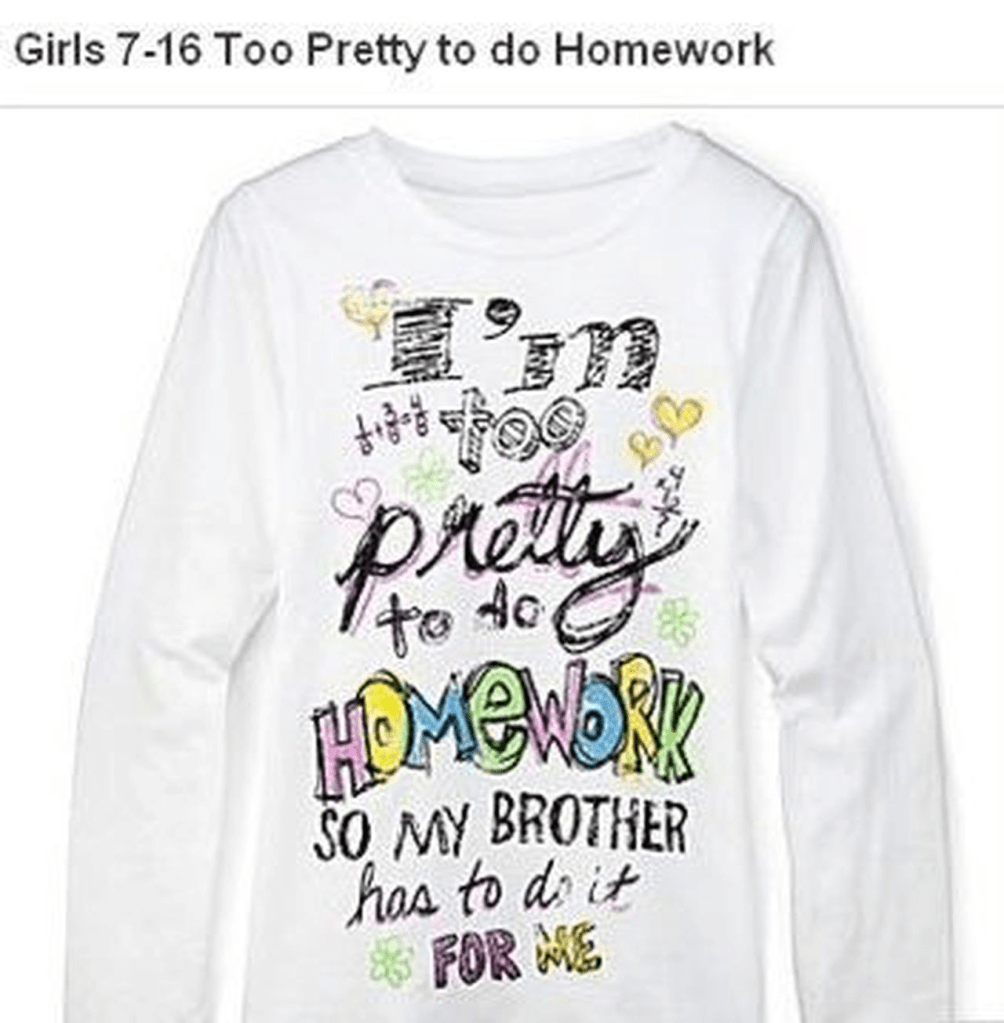
Weirdly sexualized
And of course, with all this emphasis on little girls’ looks, there is content that takes it too far. In my opinion, any slogans advertising a child’s ability to enter a relationship or referencing sexual activity is entirely wrong.
When I asked my mom about any slogans they could remember when researching for this post, they said they’d seen a baby onesie that said “dad just wanted a blowjob”. My least favorite that I’ve personally seen is “hide your daughters”. More examples can be found here, in a Pinterest board shared with me by my roommate.
Weird sexualization is easy to point out, but it wouldn’t exist on the shelves if there wasn’t support for it. It wouldn’t have gotten made if more “acceptable” gendered products, like “ladies man” and “future heartbreaker”, hadn’t built up the foundation for it to exist.
Conclusion
So boy’s clothes are built better, last longer, and trend towards toxic and aggressive masculinity. Their clothes are easier to move in, making them more capable of demonstrating physical skill. This makes them feel better than girls, and combined with their slogans bolstering their self perception and encouraging violence, they feel entitled and suppress their “softer” emotions.
Girl’s clothes are flimsier, smaller, less practical, and they encourage soft sweet and pretty femininity. The limited encouragement entirely based around their looks creates the foundation for unhealthy behavior later in life, and limits what they believe they can accomplish.
Encouraging stereotypes for children affects them as young as 2, and they can and will internalize their status as better or worse. Clothing may seem harmless and funny, but we should know what we’re condoning.
Citations
BBC. (2018, December 14). Gender stereotypes: Why do shops divide products for girls and boys?. BBC Newsround. https://www.bbc.co.uk/newsround/46530419
Beaven, K. (2023, April 13). Animals, aggression and entitlement: Boys’ clothes on the high street. SONSHINE. https://sonshinemagazine.com/blog/animals-aggression-and-entitlement#:~:text=The%20animals%20for%20boys%20were,clothes%2C%20the%20girls%20have%20prey
Bull, S. (2023, June 22). Mum discovers “message” in girls’ clothes but others say she’s overthinking. The Sun. https://www.thesun.co.uk/fabulous/19942048/mum-hidden-message-girls-clothing-others-say-overthinking/
Counihan, C. (2000). The anthropology of food and body gender, meaning and power. Routledge.
Ditlevson Haglund, J. (2017, November 16). Did you ever notice this about the clothes you grew up wearing?. Kids Clothing Patterns Girls Vs Boys Gender Stereotypes. https://www.refinery29.com/en-us/kids-clothing-sexist-message-gender-roles
Dockterman, E. (2023, August 31). How “Barbie” has affected how we think about the color pink. Time. https://time.com/6309632/is-pink-girl-color-barbie/
D’innocenzio, A. (2016, July 25). Breaking down the gender stereotypes in kids’ clothing. The Seattle Times. https://www.seattletimes.com/business/breaking-down-the-gender-stereotypes-in-kids-clothing/
Everybody Tells Me I’d Love This Article… Probably Because I Wrote It. (2023). TikTok. Retrieved November 5, 2023, from https://www.tiktok.com/@sonshinemag/video/7218949422997196038.
Feeney, I. (2022, June 24). Gender stereotyping in children’s clothing. Raemona Magazine. https://www.raemona.com/post/gender-stereotyping-in-childrens-clothing
GENDER STEREOTYPES SIGNIFICANTLY LIMITING CHILDREN’S POTENTIAL, CAUSING LIFELONG HARM – COMMISSION FINDS. Fawcett. (2020, December 15). https://www.fawcettsociety.org.uk/Handlers/Download.ashx?IDMF=a4383b4d-6869-4ea2-a9c9-d4daa87f6b47
HandWiki Li. (2022, October 19). Gendered Associations of pink and blue. Encyclopedia. https://encyclopedia.pub/entry/30019
Holmes, M. (2023, January 24). What is “sad beige” parenting, and how did we get here? HuffPost. https://www.huffpost.com/entry/sad-beige-parenting-trend_l_63c5cf84e4b0cbfd55f587f3
Linning, S. (2018, January 12). Parents horrified by the very different animals printed on girls and boys clothing – and accuse retailers of pandering to gender stereotypes with their use of “predators” and “prey.” Daily Mail Online. https://www.dailymail.co.uk/femail/article-5259053/The-different-animals-used-girls-boys-clothing.html
ParentCo. (2017, January 27). 5 unexpected gender differences in children’s clothing. https://www.parent.com/blogs/conversations/5-unexpected-gender-differences-in-childrens-clothing
Petersen, S. (2023, April 18). Why minimalism dominates Momfluencer culture on Instagram. Time. https://time.com/6270533/moms-instagram-minimalism-momfluenced-excerpt/
Redmond, R. (2023, October 29). 530 clothing ideas in 2023: Funny outfits, Funny Tshirts, hockey shirts. Pinterest. https://pin.it/2oFdCVc
Tanner, J. M. (2023, June 27). Human development. Encyclopædia Britannica. https://www.britannica.com/science/human-development
Villalpando, N. (2018, September 25). Why do girls’ clothes seem smaller than boys’ clothes? because they are. Statesman. https://www.statesman.com/story/news/2017/05/30/why-do-girls-clothes-seem-smaller-than-boys-clothes-because-they-are/10048464007/#:~:text=Choksi%20measured%2010%20brands%20of,percent%20shorter%20in%20the%20inseams
 Jules Dragon Fashion
Leave a comment